How to take measurements for industrially and individually made shoes
Accurate measurements of the foot and lower extremities are a mandatory component of prescribing orthopedic shoes, and they must be included in the specialist's report in the E-health system under the section describing functional impairments. These measurements serve as an objective basis for the decision on the most suitable type of shoe — industrially made or individually made shoes.
The correct choice of orthopedic shoes is essential to ensure patient safety, stability of the ankle, foot, and foot joints, to slow the progression of deformities, reduce pain, and provide functional support. The decision between industrially and individually made shoes is based on standardized measurements, the severity of deformity, and the patient's functional needs.
How to take measurements for industrially and individually made shoes
Accurate measurements of the foot and leg are very important for prescribing orthopedic shoes. They must always be recorded in the specialist's report in the E-health system under the section “description of functional impairments”.
These measurements provide a clear basis for the decision on which shoes are better for a specific person – industrially made shoes or individually made shoes.
The correct choice of orthopedic shoes is very important. It helps:
- ensure patient safety,
- ensure stability of the ankle, foot, and foot joints,
- slow the development of foot and leg deformities,
- reduce pain,
- improve daily movement and activities.
The decision between industrially and individually made shoes is based on:
- equally performed (standardized) measurements,
- the severity of deformity,
- the patient's daily functional needs, such as how much a person walks, stands, or performs other movements.
Why are measurements important?
Accurate foot and lower limb measurements are the basis for choosing the right shoes. They allow:
to objectively determine the severity of deformity,
to assess foot biomechanics,
to determine the necessary amount of correction,
to understand whether ready-made shoes are sufficient or if custom-made shoes are needed.
Without standardized measurements, a healthcare professional cannot reasonably choose the most suitable type of shoe.
Why are measurements important?
Accurate foot and leg measurements help choose the right shoes. They are the basis for good shoe selection.
Measurements help:
- to understand how severe the foot deformity is (the shape of the foot has changed),
- to understand how the foot moves when a person stands and walks,
- to determine how much correction the foot needs,
- to understand whether regular store-bought shoes are sufficient,
- to understand whether custom-made shoes specifically for the person are needed.
If measurements are not taken uniformly, a doctor or other healthcare professional cannot confidently choose the most appropriate type of shoe.
Industrially manufactured shoes are suitable if:
deformations are mild or moderately pronounced,
the difference in foot length is up to 3 cm,
additional support is needed,
standard shoes do not fit, but there are no severe structural changes,
there are sensory or circulation disorders that require a special shoe construction.
Custom-made shoes are necessary if:
there is a shortening of the lower extremity by 3–16 cm,
there are pronounced foot or ankle deformations,
there is ankle instability, contractures, lymphostasis,
industrially manufactured shoes cause pain or do not fit,
hard orthoses need to be worn daily,
there is partial foot amputation.
The importance of foot measurements in decision-making
When prescribing shoes, the healthcare professional must take the following measurements, which allow for accurate determination of whether the patient can use industrially manufactured shoes or if custom-made shoes are necessary:
Hallux Valgus angle (HVA)
Industrially manufactured shoes are good if:
- foot deformations are mild or moderate,
- the difference in foot length is up to 3 cm,
- additional support is needed,
- regular shoes do not fit, but there are no severe foot or ankle injuries,
- there are sensory disorders (e.g., numbness) or circulation disorders, and therefore a special shoe construction is needed.
Custom-made shoes are needed if:
- the lower leg is shorter than the other by 3–16 cm,
- there are severe foot or ankle deformations,
- there is ankle instability (the ankle easily twists),
- there are contractures (the joint moves poorly and is stiff),
- there is lymphostasis (the leg is swollen due to poor lymph drainage),
- industrially manufactured shoes cause pain or do not fit at all,
- hard orthoses need to be worn daily (stiff supports for the leg or ankle),
- there is partial foot amputation (part of the foot has been cut off).
The importance of foot measurements in decision-making
The doctor or other healthcare professional, when prescribing shoes, must take the following measurements. They help to understand whether industrially manufactured shoes are sufficient or if custom-made shoes are needed:
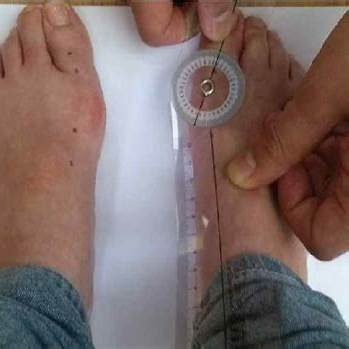
- Hallux Valgus angle (HVA) – this is the angle of deviation of the big toe, for example, at the “bump” at the big toe.
Patient's position: The patient stands upright, fully loaded on both bare feet.
Instruction:
Look at the foot from above and determine two axes:
1. axis of the metatarsal bone,
the axis of the big toe.
Place the center of the goniometer at the 1st MTP joint.
Align one shoulder of the goniometer with the axis of the 1st metatarsal bone, the other with the axis of the big toe.
Read the angle and record: R/L + HVA degrees (for example: R HVA 18°).
Note: Measurements should be taken under the same conditions.
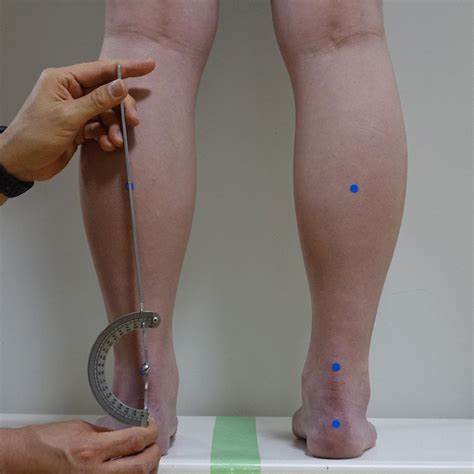
Pes valgus/pes varus angle
Pes valgus / pes varus angle
This is the angle of the foot.
- “Pes valgus” means that the foot turns outward. Example: you are standing, and the ankles tilt inward, but the toes and heel of the foot are pointing more outward.
- “Pes varus” means that the foot turns inward. Example: you are standing, and the foot is more supported on the outer edge, as if it bends inward.
This angle is measured by a doctor to understand how much the foot turns outward or inward.
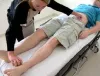
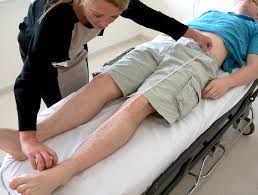
Patient position: The patient lies on their back, legs straight, feet neutral.
Instructions:
Ensure that the pelvis is straight, knees equally extended.
Locate the SIAS.
Attach the measuring tape “0” point to the -SIAS.
Pull the measuring tape to the medial malleolus.
Record: R/L + cm (for example: R 92.5 cm).
Repeat for the other leg and calculate Δ.
Note: Always use the same reference points and take two measurements.
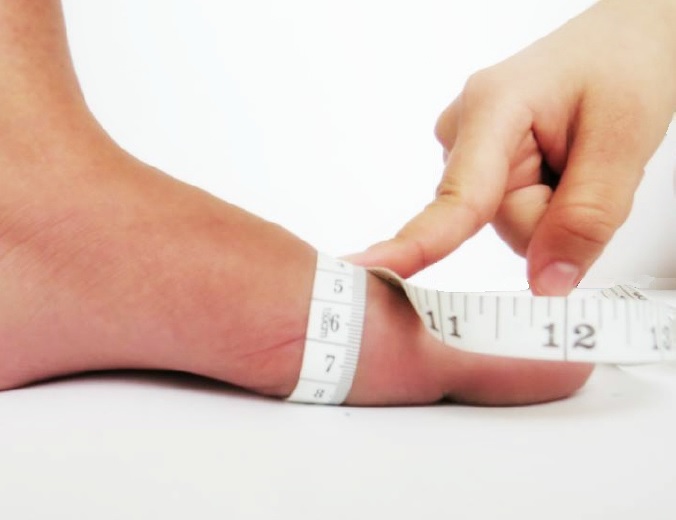
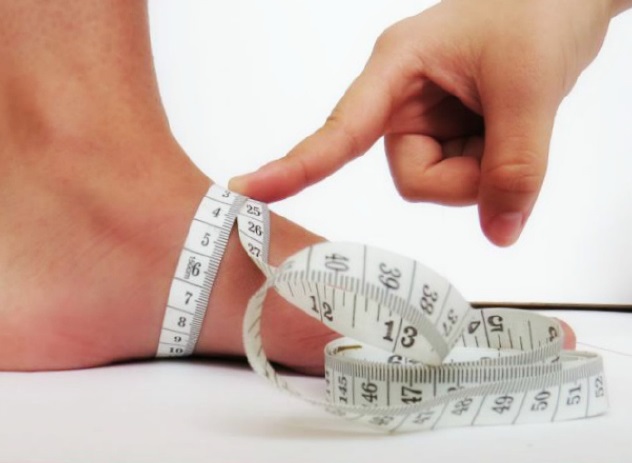
Measuring foot circumference
This is done to assess the volume and shape of the foot. Measured while standing, with a measuring tape
Foot circumference is measured to understand the size and shape of the foot.
The person stands on their feet.
A measuring tape is wrapped around the foot.
This determines how large the foot is.
 +371 67 552 350
 vtpc@nrc.lv